This is a short clip in chronological order showing the storyboard and each scene. It has been drawn up by hand and the pictures have been merged together for the 'rolling' film camera effect.
Tuesday, 15 January 2013

Friday, 11 January 2013
Film Synopsis
Film: Synopsis
At the beginning of our movie, we will have a fight to signal the intent of a fast paced action movie. There will be two villains as well as a victim where the villains don't quite understand his actual power. This fight scene will be set in an alleyway and the scene will actually start in the middle of the fight .
The victim doesn't seem scared to show that the villains won't get away with it and so one of his bits of dialogue will be " Do you even know who I am," Eventually the victim gets killed and the villains return back to base. This base is where their report to for their boss.
We aren't going to show a full shot of the boss but extreme close ups because it will add up to the mysteriousness of the boss. Not only does this take the prevalence of him a bit, but it gives more prevalence to one of the villains who the audience will identify that he is trying to get away from this life.
towards the end of the two minutes, the boss gives the villain a new target and then the villain receives a call from someone who wants revenge for the murder of the character at the beginning of the movie.
At the beginning of our movie, we will have a fight to signal the intent of a fast paced action movie. There will be two villains as well as a victim where the villains don't quite understand his actual power. This fight scene will be set in an alleyway and the scene will actually start in the middle of the fight .
The victim doesn't seem scared to show that the villains won't get away with it and so one of his bits of dialogue will be " Do you even know who I am," Eventually the victim gets killed and the villains return back to base. This base is where their report to for their boss.
We aren't going to show a full shot of the boss but extreme close ups because it will add up to the mysteriousness of the boss. Not only does this take the prevalence of him a bit, but it gives more prevalence to one of the villains who the audience will identify that he is trying to get away from this life.
towards the end of the two minutes, the boss gives the villain a new target and then the villain receives a call from someone who wants revenge for the murder of the character at the beginning of the movie.
R&P - Storyboard
Storyboard
This is our storyboard, which is a strong idea of what the shots in our opening two minutes is going to look like, if for any reason any altercations need to made then we will do so in the filming and editing process. It gives details of the shot type, the length of each shot, and the camera angles and movement used in each shot. It also gives information of the type of sound, and any dialogue included in the scene. All the scenes are shown below starting from the top to bottom in chronological order:


This is our storyboard, which is a strong idea of what the shots in our opening two minutes is going to look like, if for any reason any altercations need to made then we will do so in the filming and editing process. It gives details of the shot type, the length of each shot, and the camera angles and movement used in each shot. It also gives information of the type of sound, and any dialogue included in the scene. All the scenes are shown below starting from the top to bottom in chronological order:
Sunday, 30 December 2012
R&P - Shot Types
There is a convention in all of the video, film and television
industries which assigns names and guidelines to common types of shots, framing
and picture composition. The list below briefly describes the most common shot
types (click the images for more details).
The exact terminology varies between production environments
but the basic principles are the same.
Shots are usually described in relation to a particular
subject. In most of the examples below, the subject is the boy.
EWS (Extreme Wide Shot)
The view is so far from the subject that he isn't even visible. Often used as an establishing shot.

VWS (Very Wide Shot)
The subject is visible (barely), but the emphasis is still on placing him in his environment.

WS (Wide Shot)
The subject takes up the full frame, or at least as much as comfortably possible.
AKA: long shot, full shot.


(OSS) Over-the-Shoulder Shot
Looking from behind a person at the subject.

Point-of-View Shot (POV)
Shows a view from the subject's perspective.
This shot shows a view from the subject's perspective. It is usually edited in such a way that it is obvious whose POV it is.

EWS (Extreme Wide Shot)
The view is so far from the subject that he isn't even visible. Often used as an establishing shot.
In the extreme wide shot, the view is so far from the subject that s/he isn't even visible. The point of this shot is to show the subject's surroundings.
The EWS is often used as an "establishing shot" - the first shot of a new scene, designed to show the audience where the action is taking place.
It is also useful in scenes where the action is very spread out. For example, in a war movie an extreme wide shot can show the scale of the action.
VWS (Very Wide Shot)
The subject is visible (barely), but the emphasis is still on placing him in his environment.
The very wide shot is much closer to the subject than an extreme wide shot, but still much further away than a wide shot. The subject is visible here but only just (in this case it's a boy leaning against the fence). The emphasis is very much on placing him in his environment.
This often works as an establishing shot, in which the audience is shown the whole setting so they can orient themselves.
The VWS also allows plenty of room for action to take place, or for multiple subjects to appear on screen.
WS (Wide Shot)
The subject takes up the full frame, or at least as much as comfortably possible.
AKA: long shot, full shot.
In the wide shot, the subject takes up the full frame. In this case, the boy's feet are almost at the bottom of frame and his head is almost at the top. Obviously the subject doesn't take up the whole width and height of the frame, since this is as close as we can get without losing any part of him. The small amount of room above and below the subject can be thought of as safety room — you don't want to be cutting the top of the head off. It would also look uncomfortable if his feet and head were exactly at the top and bottom of frame.
As with many shot types, the wide shot means different things to different people. However the wide shot seems to suffer more from varying interpretations than other types. Many people take the WS to mean something much wider than our example, i.e. what we would call a very wide shot.
MS (Mid Shot)
Shows some part of the subject in more detail while still giving an impression of the whole subject.
Shows some part of the subject in more detail while still giving an impression of the whole subject.
The mid shot shows some part of the subject in more detail, whilst still showing enough for the audience to feel as if they were looking at the whole subject. In fact, this is an approximation of how you would see a person "in the flesh" if you were having a casual conversation. You wouldn't be paying any attention to their lower body, so that part of the picture is unnecessary.
The MS is appropriate when the subject is speaking without too much emotion or intense concentration. It also works well when the intent is to deliver information, which is why it is frequently used by television news presenters. You will often see a story begin with a MS of the reporter (providing information), followed by closer shots of interview subjects (providing reactions and emotion).
As well as being a comfortable, emotionally neutral shot, the mid shot allows room for hand gestures and a bit of movement.
MCU (Medium Close Up)
Half way between a MS and a CU.
Half way between a MS and a CU.
The medium closeup is half way between a mid shot and a close up. This shot shows the face more clearly, without getting uncomfortably close.
CU (Close Up)
A certain feature or part of the subject takes up the whole frame.
A certain feature or part of the subject takes up the whole frame.
In the closeup shot, a certain feature or part of the subject takes up most of the frame. A close up of a person usually means a close up of their face (unless specified otherwise).
Close-ups are obviously useful for showing detail and can also be used as a cut-in.
A close-up of a person emphasizes their emotional state. Whereas a mid-shot or wide-shot is more appropriate for delivering facts and general information, a close-up exaggerates facial expressions which convey emotion. The viewer is drawn into the subject's personal space and shares their feelings.
A variation is the chocker shot which is typically framed on the subject's face from above the eyebrows to below the mouth.
ECU (Extreme Close Up)
The ECU gets right in and shows extreme detail.
The ECU gets right in and shows extreme detail.
The ECU (also known as XCU) gets right in and shows extreme detail.
You would normally need a specific reason to get this close. It is too close to show general reactions or emotion except in very dramatic scenes.
A variation of this shot is the choker.
Cut-In
Shows some (other) part of the subject in detail.
Shows some (other) part of the subject in detail.
Like a cutaway, but specifically refers to showing some part of the subject in detail.
Can be used purely as an edit point, or to emphasize emotion etc. For example, hand movements can show enthusiasm, agitation, nervousness, etc.

CA (Cutaway)
A shot of something other than the subject.
A shot of something other than the subject.
A cutaway is a shot that's usually of something other than the current action. It could be a different subject (eg. this cat when the main subject is its owner), a close up of a different part of the subject (eg. the subject's hands), or just about anything else.
The cutaway is used as a "buffer" between shots (to help the editing process), or to add interest/information.
Two-Shot
A shot of two people, framed similarly to a mid shot.
A shot of two people, framed similarly to a mid shot.
There are a few variations on this one, but the basic idea is to have a comfortable shot of two people. Often used in interviews, or when two presenters are hosting a show.
A "One-Shot" could be a mid-shot of either of these subjects. A "Three-Shot", unsurprisingly, contains three people.
Two-shots are good for establishing a relationship between subjects. If you see two sports presenters standing side by side facing the camera, you get the idea that these people are going to be the show's co-hosts. As they have equal prominence in the frame, the implication is that they will provide equal input. Of course this doesn't always apply, for example, there are many instances in which it's obvious one of the people is a presenter and the other is a guest. In any case, the two-shot is a natural way to introduce two people.
A two-shot could also involve movement or action. It is a good way to follow the interaction between two people without getting distracted by their surroundings.
(OSS) Over-the-Shoulder Shot
Looking from behind a person at the subject.
This shot is framed from behind a person who is looking at the subject. The person facing the subject should usually occupy about 1/3 of the frame.
This shot helps to establish the position of each person, and get the feel of looking at one person from the other's point of view.
It's common to cut between these shots during a conversation, alternating the view between the different speakers.
Point-of-View Shot (POV)
Shows a view from the subject's perspective.
This shot shows a view from the subject's perspective. It is usually edited in such a way that it is obvious whose POV it is.
Wednesday, 19 December 2012
R&P - Intro Analysis
The way a film opens up to the audience varies from genre to genre. The trailer below fits perfectly with the action theme of our genre, the intro to this movie immediately catches the audiences eyes, and the transition effects add more eye swirling movements which gives off the impression of the movie being a blockbuster.
Tuesday, 18 December 2012
Props to use
Props are essential ingredients for any movie, or such filming genres, they provide the vital sense of any film, which is 'realism'. A theatrical property, commonly referred to as a prop, is an object used on set/stage by actors to further the plot or story line of a movie. Smaller props are referred to as "hand props". Larger props may also be set decoration, such as a chair or table. The difference between a set decoration and a prop is use. If the item is not touched by a performer for any reason it is simply a set decoration. If it is touched by the actor in accordance to script requirements or as deemed by the director, it is a prop.


Working in
coordination with the set designer, costume designer, lighting and sometimes,
sound designer, this overlapping position has only in recent years become of
greater importance. Props have become more and more specialized due in large
part to realism as well as the rise of theatre in the round,
where few sets are used and the simple prop becomes as important a design
element as costumes and lighting.
Besides the obvious artistic creations made in the prop
workshop, much of the work done by the property designer is research, phone
searches, and general footwork in finding needed items. Prop designers are not
always credited in theater, but film credits for full staff of designers, artisans
and craftsmen are much more common.
As our genre is urban/action, we will have a dangerous weapon such as a gun and a hand knife, probabaly a shank, all fake of course.


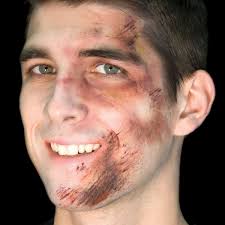
Other props that we use are small props such as, fake blood, make-up for bruised effects and jewellery for distinguising between the status of the characters.


Monday, 17 December 2012
R&P - Location
The location of the film assignment may vary, however my group and I have been sampling a few locations as our genre is urban/action, and this one, personally for me stands out as a major competitor. The elements in this location such as, good lighting in areas of action, dark areas for concealed mysteriousness, and urban style graffiti on the walls will ultimately influence our choice to choose this location for filming.


Film Production Companies - Paramount Pictures
Paramount Pictures Corporation is a film and television production/distribution company, consistently ranked as one of the largest (top-grossing) movie studios. It is a division of American media conglomerate Viacom.
The company dates its beginnings to the 1912 founding date of the Famous Players Film Company, one of the companies that merged into Paramount Pictures (then known as Famous Players-Lasky Corporation) in 1916. Paramount is the fourth oldest existing film studio in the world behind Universal Studios, Pathé and Gaumont Pictures. Also, it is the last major film studio still headquartered in the Hollywood district of Los Angeles, remarkably it is the fourth oldest film studio in the world.
Paramount Pictures

Here are a few films produced with the involvement of paramount pictures:
Paul (2011)

Tower Heist (2011)

Transformers (2007)

The company dates its beginnings to the 1912 founding date of the Famous Players Film Company, one of the companies that merged into Paramount Pictures (then known as Famous Players-Lasky Corporation) in 1916. Paramount is the fourth oldest existing film studio in the world behind Universal Studios, Pathé and Gaumont Pictures. Also, it is the last major film studio still headquartered in the Hollywood district of Los Angeles, remarkably it is the fourth oldest film studio in the world.
Paramount Pictures
Here are a few films produced with the involvement of paramount pictures:
Paul (2011)
Tower Heist (2011)
Transformers (2007)
Friday, 14 December 2012
Film Questionnaire
The film questionnaire design which I had posted a few days ago has been filled out by anonymous volunteers and the picture below is a finished questionnaire from which I will conduct an analysis and post the results as soon as possible.
Here is the evaluation of the questionnaires' results:


Here is the evaluation of the questionnaires' results:


Thursday, 13 December 2012
Film Production Companies - Universal Studios
Universal Studios (also known as Universal Pictures), is an American motion picture studio, owned by Comcast, and one of the six major movie studios. It is one of the longest-lived motion picture studios to be located outside of Hollywood. It is a division of American media conglomerate NBCUniversal.
Founded in 1912 by Carl Laemmle, Mark Dintenfass, Charles Baumann, Adam Kessel, Pat Powers, William Swanson, David Horsley, and Jules Brulatour, it is the oldest movie studio in the United States of America. It is also the third oldest in the world that is still in continuous production; the first being Gaumont Pictures, the second oldest is Pathé and the fourth oldest is Paramount Pictures. On May 11, 2004, the controlling stake in the company was sold by Vivendi Universal to General Electric, parent of NBC.
The resulting media super-conglomerate was renamed NBC Universal, while Universal Studios Inc. remained the name of the production subsidiary. In addition to owning a sizable film library spanning the earliest decades of cinema to more contemporary works, it also owns a sizable collection of TV shows through its subsidiary NBC Universal Televsion Distribution. It also acquired rights to several prominent filmmakers' works originally released by other studios through its subsidiaries over the years. Selected clips and footage shot by Universal Studios are available for purchase from the NBC Universal Archives.
Its production studios are at 100 Universal City Plaza Drive in Universal City California. Distribution and other corporate offices are in New York City.

Here are a few films produced with the involvement of Universal Studios:
Jurassic Park (1993)

Battleship(2012)

The Bourne Identity (2002)

Founded in 1912 by Carl Laemmle, Mark Dintenfass, Charles Baumann, Adam Kessel, Pat Powers, William Swanson, David Horsley, and Jules Brulatour, it is the oldest movie studio in the United States of America. It is also the third oldest in the world that is still in continuous production; the first being Gaumont Pictures, the second oldest is Pathé and the fourth oldest is Paramount Pictures. On May 11, 2004, the controlling stake in the company was sold by Vivendi Universal to General Electric, parent of NBC.
The resulting media super-conglomerate was renamed NBC Universal, while Universal Studios Inc. remained the name of the production subsidiary. In addition to owning a sizable film library spanning the earliest decades of cinema to more contemporary works, it also owns a sizable collection of TV shows through its subsidiary NBC Universal Televsion Distribution. It also acquired rights to several prominent filmmakers' works originally released by other studios through its subsidiaries over the years. Selected clips and footage shot by Universal Studios are available for purchase from the NBC Universal Archives.
Its production studios are at 100 Universal City Plaza Drive in Universal City California. Distribution and other corporate offices are in New York City.
Here are a few films produced with the involvement of Universal Studios:
Jurassic Park (1993)
Battleship(2012)
The Bourne Identity (2002)
Subscribe to:
Posts (Atom)